How Long Does It Take for Oral Probiotics to Work? (And What to Expect Week by Week)
If you’ve started taking an oral probiotic and are wondering whether it’s actually doing anything — you’re asking the right question, and the honest answer is more nuanced than most product pages will tell you.
The short version: most people notice the first effects between days 7 and 14, but the most meaningful changes take 4 to 8 weeks of consistent daily use. Here’s exactly what happens in your mouth during that window, and what to watch for at each stage.
First: Why Oral Probiotics Work Differently Than Gut Probiotics
Most people are familiar with digestive probiotics — the kind you swallow to support gut health. Oral probiotics work on a completely different ecosystem.
Your mouth hosts over 700 species of bacteria, forming what researchers call the oral microbiome. Unlike the gut, where probiotics travel through to the intestine, the oral microbiome is directly accessible — which means the bacteria from an oral probiotic can begin establishing themselves in your mouth immediately.
The delivery method matters enormously here. Oral probiotics are designed to be dissolved slowly in the mouth — not swallowed whole like a gut probiotic capsule. This slow dissolution allows the beneficial bacterial strains to coat the surfaces of your teeth, gums, tongue, and cheeks before being swallowed. A probiotic swallowed immediately bypasses this entirely.
Week by Week: What Actually Happens
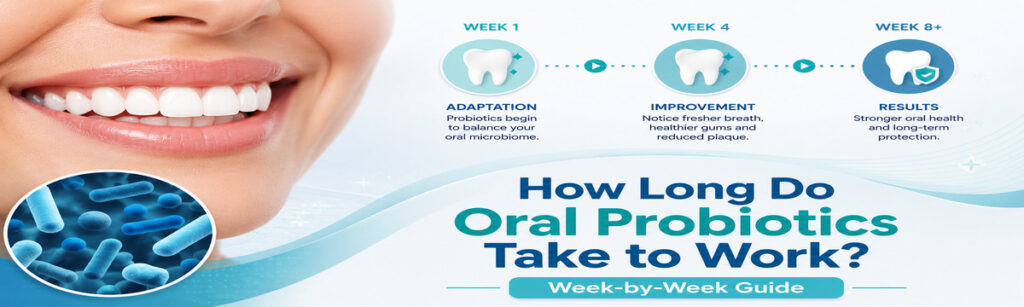
Days 1–3: Establishment phase
Nothing dramatic. The beneficial bacterial strains from the probiotic are beginning to colonize the surfaces of your oral cavity. You won’t feel this happening. The primary activity is competitive — the introduced strains are beginning to compete with established bacteria for adhesion sites on oral surfaces.
Some people notice a very mild change in saliva consistency or a slightly different taste during this period. This is normal and temporary.
Days 4–7: Early competition
By the end of the first week, the introduced strains — particularly Lactobacillus Reuteri and Lactobacillus Paracasei in well-formulated products — are beginning to establish a meaningful presence. Research on L. Reuteri specifically shows that it begins producing antimicrobial compounds (reuterin) within the first week of colonization, which start displacing Streptococcus mutans — the primary bacteria responsible for tooth decay.
You probably won’t notice anything visible yet, but the microbiome shift is underway.
Days 7–14: First noticeable effects — breath
The most commonly reported first change is fresher breath, typically noticed around days 7 to 10. This makes biological sense: bad breath (halitosis) is primarily caused by volatile sulfur compounds produced by specific bacteria in the mouth. As beneficial strains begin displacing these bacteria, their sulfur compound production decreases.
If you’re going to notice something in the first two weeks, this is almost certainly what it will be.
Weeks 2–4: Gum response begins
The gum health effects — reduced sensitivity, less bleeding during brushing, calmer tissue along the gum line — typically start becoming noticeable in weeks two through four. This is when the L. Reuteri research shows the most significant anti-inflammatory effects on gum tissue.
A 2020 clinical study found that L. Reuteri supplementation over four weeks produced significant reductions in plaque index and gingivitis scores compared to placebo. If your dentist has mentioned “mild inflammation” or “early gingivitis” at past visits, this four-week window is when meaningful gum improvement typically first becomes measurable.
Weeks 4–8: Cumulative microbiome stabilization
Between weeks four and eight, the beneficial bacterial strains reach a more stable colonization — meaning they’re not just temporarily present but have established a sustained foothold in your oral microbiome. This is when users report the most consistent and lasting improvements in breath freshness and gum comfort.
Whitening effects from ingredients like malic acid, if present in the formula, may become subtly noticeable in this window — though these are surface-level and modest rather than dramatic.
Weeks 8–12: Full baseline established
By the end of three months, most people have reached the full benefit their individual microbiome and formula combination will produce. What you’re experiencing at this point represents your new baseline — and importantly, this baseline is maintained by continued daily use rather than being permanent after you stop.
Frequently Asked Questions
What if I don’t notice anything in the first two weeks?
Two weeks is early. The breath improvement is the fastest signal, but not everyone notices it at the same time — individual oral microbiome composition varies significantly, and a healthier baseline means less dramatic initial change. The gum and tissue effects take longer regardless of formula quality. Give it at least four weeks before drawing conclusions.
Do I need to stop using mouthwash?
This depends on the type of mouthwash. Antiseptic mouthwashes — particularly those containing chlorhexidine or high concentrations of alcohol — kill bacteria broadly, including the beneficial strains you’re trying to establish. Using antiseptic mouthwash immediately before or after your oral probiotic essentially undoes the colonization work.
If you use mouthwash, either switch to a fluoride-based (non-antiseptic) formula, or use it at a different time of day — not within an hour of your oral probiotic.
Should I take oral probiotics before or after brushing?
After brushing is generally recommended. Brushing physically removes bacteria from oral surfaces, so taking the probiotic afterward means the beneficial strains have clean surfaces to adhere to without competing immediately with the biofilm you just disrupted.
Can I swallow the tablet immediately?
You can, but it’s significantly less effective. The whole point of the slow-dissolve tablet format is to coat your oral surfaces before the bacteria are swallowed into the acidic stomach environment. Swallowing immediately converts an oral probiotic into a much weaker gut probiotic.
What happens if I stop taking it?
The beneficial effects don’t disappear overnight, but they do gradually diminish as the colonized strains are outcompeted by returning bacteria without continued reinforcement. Most studies suggest measurable microbiome changes begin reversing within 2–4 weeks of discontinuation. For sustained benefit, consistent daily use is necessary.
Can children take oral probiotics?
Most oral probiotic strains used in human research are considered safe for children, but formulas designed for adults may contain doses higher than necessary for pediatric use. Consult a pediatric dentist before giving oral probiotics to children, especially under age 12.
Does diet affect how well oral probiotics work?
Yes, meaningfully. A diet high in sugar feeds Streptococcus mutans and other acidogenic bacteria that oral probiotics are trying to displace — creating ongoing competition that slows colonization. Reducing sugar intake, particularly between meals, gives the beneficial strains a better environment to establish themselves. This doesn’t mean the probiotic won’t work on a normal diet — it means it works better with less sugar.
Will I see improvement on my next dental visit?
Potentially, yes — particularly if your dentist tracks gum measurements or inflammatory tissue scores. In my own experience reviewing ProDentim, a dental hygienist noticed improved gum measurements and reduced tissue inflammation at a routine cleaning around week seven of use. Not all dentists track these metrics at every visit, but it’s worth mentioning to yours and asking them to compare.
Is there a difference between oral probiotic brands?
Significantly, yes. The key differences to look for: which specific bacterial strains are included (L. Reuteri and L. Paracasei have the most direct oral health evidence), CFU count (the number of live cultures), whether the formula is a slow-dissolve tablet or a swallowable capsule (slow-dissolve is correct for oral application), and whether it includes prebiotic support (inulin or similar) to help the introduced strains establish. Products that cut corners on any of these have less clinical grounding.
Signs That Your Oral Probiotic Is Working
Look for these signals in roughly this order:
- Fresher breath throughout the day (weeks 1–2) — particularly noticeable in the morning and after meals
- Reduced post-meal taste persistence (weeks 2–3) — the lingering taste after eating clears faster
- Less gum sensitivity during brushing (weeks 3–5) — the discomfort along the gum line when brushing reduces
- Reduced bleeding when flossing (weeks 4–6) — healthy gum tissue bleeds less
- Dentist notices improved gum scores (weeks 6–12) — measurable rather than subjective
The Bottom Line
Oral probiotics work, but they work on a biological timeline that requires patience. The first two weeks are mostly invisible establishment work. Weeks three through six are when the first functional improvements typically surface. Full microbiome stabilization takes two to three months.
The most important thing you can do to maximize results: don’t swallow the tablet immediately, don’t use antiseptic mouthwash right before or after, and give it at least four weeks before judging effectiveness.
For a detailed look at a specific oral probiotic formula — including ingredient analysis and a 60-day personal experience — read our full review:
→ ProDentim Review 2026: I Took This Oral Probiotic Daily for 60 Days